CoinDCX and Delta Exchange both are leading crypto trading platform in India. They are also leading in Trader’s favorite crypto future trading.
Whether you’re a long-term investor buying crypto occasionally or an active trader placing multiple trades daily, understanding fee structures is essential before selecting a platform.
| Feature | CoinDCX | Delta Exchange India |
|---|---|---|
| Founded | 2018, Mumbai | 2018, Mumbai |
| FIU-IND Registered | Yes | Yes |
| Users | 20 million (2 Crore+) registered users | Delta Exchange does not publicly disclose |
| Spot Trading | Yes | YES |
| Futures Trading | Yes | Yes |
| Options Trading | Yes | Yes |
| Move Contracts | No | Yes |
| Leverage | upto 100x | up to 200x |
| Futures Fees | Maker Fee – 0.02% Taker Fee – 0.05% | Maker Fee – 0.02% Taker Fee – 0.05% |
| INR Deposits | Yes — UPI, IMPS, NEFT, bank transfer | Yes — UPI, IMPS, NEFT, bank transfer |
| INR Withdrawals | Yes — direct to bank | Yes — direct to bank |
| Settlement Currency | INR + crypto | INR only (all P&L in Rupees) |
| TDS Handling | Auto-deducted (1%) | Auto-deducted (1%) |
What is Crypto Future Trading Fees?
Crypto futures, often called perpetual futures contracts, are popular because traders can make money when cryptocurrency prices go up or down. However, many beginners do not understand the real cost of trading.
Before starting crypto futures trading, it is important to learn about all trading fees, including both visible charges and hidden costs. Crypto futures trading fees are costs charged by exchanges when you open, close, or maintain leveraged derivative positions.
1. Maker Fee:
A maker is a trader who adds liquidity to an exchange by placing limit orders that do not execute immediately. These orders stay in the order book until another trader matches them. Makers help create a smoother and more active market, so exchanges often charge lower maker fees.
Example:
- BTC price = $100,000
- You open a $10,000 BTC futures position
- Exchange maker fee = 0.02%
Maker Trading Fee = $10,000 × 0.02% = $2
2. Taker Fee:
A taker is a trader who removes liquidity by placing an order that executes instantly against an existing order in the order book. Takers use market prices or instantly matched orders to complete trades quickly.
Example:
- BTC futures trade size = $10,000
- Taker fee = 0.05%
Fee = $10,000 × 0.05% = $5
3. Funding Fee (Perpetual Futures Only):
A funding fee is a payment exchanged between traders in perpetual futures contracts. Unlike regular futures, perpetual futures do not have an expiry date, so exchanges use funding fees to keep the futures price close to the actual market (spot) price.
Example:
- BTC perpetual position = $20,000
- Funding rate = 0.01%
Funding fee = $20,000 × 0.01% = $2
Full Example (Total Cost)
- Position size = $5,000
- Leverage = 10×
- Taker fee = 0.05%
- Funding fee = 0.01%
Open trade fee:
$5,000 × 0.05% = $2.50
Close trade fee:
$5,000 × 0.05% = $2.50
Funding fee:
$5,000 × 0.01% = $0.50
Total trading cost = $5.50
CoinDCX Vs Delta Exchange Trading Fees Comparison
CoinDCX, crypto futures trading fees mainly depend on whether you place a Maker order (adds liquidity) or a Taker order (executes instantly). CoinDCX also uses a VIP fee system where higher 30-day trading volume can reduce fees.
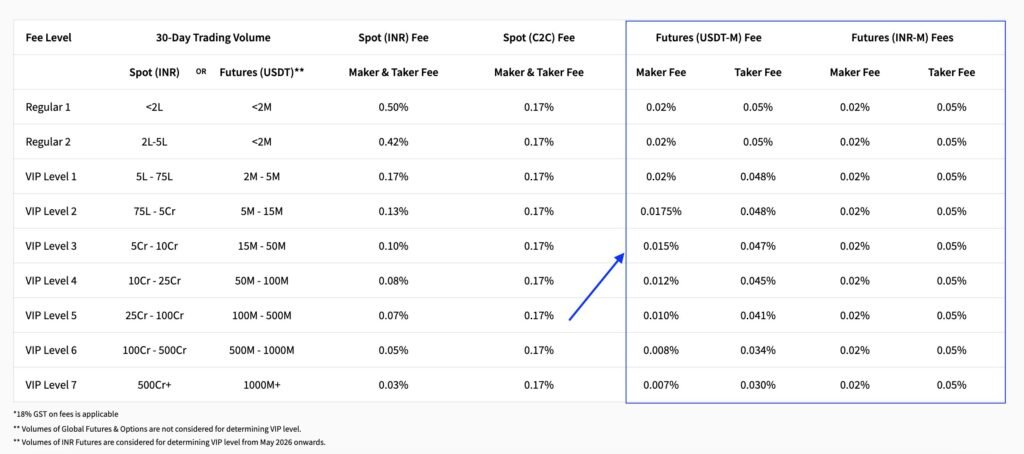
For regular users in USDT-M Futures, Maker fee starts around 0.02% and Taker fee around 0.05%. An additional 18% GST applies on trading fees in India. Fee levels update weekly based on recent trading volume.
Example:
- Capital = ₹5,000
- Leverage = 10×
- Position size = ₹50,000
- Order type = Market Order (Taker)
- Taker fee = 0.05%
- GST = 18% on fee
Delta Exchange uses a maker–taker fee model for crypto futures trading. Fees are calculated on Notional Value (full trade size) instead of only your margin amount. Notional Value means: Asset Price × Quantity.
For futures trading, Delta Exchange commonly charges around 0.02% Maker Fee and 0.05% Taker Fee on many futures products.
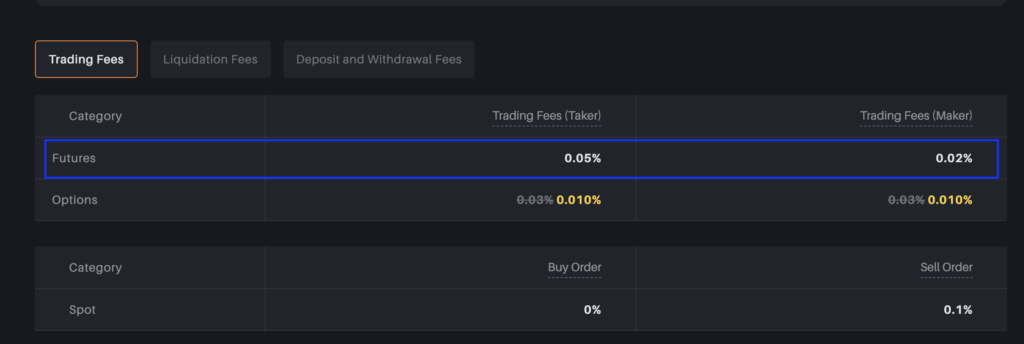
Indian users may also see 18% GST applied on trading fees.
Example:
- Capital = ₹5,000
- Leverage = 10×
- Position Size = ₹50,000
- Order Type = Market Order (Taker)
- Taker Fee = 0.05%
- GST = 18%
Are deposit fees free on both CoinDCX and DeltaExchange India exchanges?
Yes, both CoinDCX and Delta Exchange currently offer free INR deposits for Indian users. CoinDCX allows users to deposit INR through methods like IMPS, NEFT, and bank transfers without charging a deposit fee, while Delta Exchange India also supports free INR deposits via UPI, IMPS, and NEFT.
However, the main difference is that CoinDCX supports actual crypto deposits and spot trading, whereas Delta Exchange India mainly focuses on crypto futures and options trading and does not support crypto deposits on its India platform.
Are maker and taker fees fixed or volume-based?
CoinDCX and Delta Exchange use a volume-based fee structure for futures trading, not fixed fees. This means your maker and taker fees decrease as your 30-day trading volume increases.
On Delta Exchange, active traders usually get significantly lower fees at higher volume tiers, and maker fees can become very low compared to taker fees. CoinDCX also follows tiered pricing, but the discounts and liquidity advantages are generally more attractive on Delta for frequent futures traders.
Which platform is better for crypto scalping traders?
For crypto scalping, Delta Exchange is usually the better choice compared to CoinDCX. Scalping depends heavily on low fees, tight spreads, fast order execution, good liquidity, and advanced futures tools areas where Delta Exchange performs better because it is built mainly for derivatives trading.
When comparing trading fees between CoinDCX and Delta Exchange, the better platform mainly depends on your trading style. CoinDCX is more suitable for spot investors and casual traders because it offers competitive spot trading fees along with easy INR deposits and a beginner-friendly ecosystem.
On the other hand, Delta Exchange is generally more cost-effective for active futures and scalping traders due to its lower maker fees, better derivatives liquidity, and volume-based fee discounts. Delta’s futures maker fee can go as low as 0.02% compared to CoinDCX futures fees that are typically slightly higher for most users.
For high-frequency futures trading, many traders prefer Delta Exchange because lower fees and tighter spreads can significantly improve profitability over time.
CoinDCX remains a strong option for users who want both spot investing and occasional futures trading within a single platform. Overall, if your primary focus is crypto futures, options, or scalping, Delta Exchange usually provides better fee efficiency, while CoinDCX is better suited for long-term investors and beginners.